
WHY PI SYSTEM ENVIRONMENTS NEED DEDICATED RUN-AND-MAINTAIN OWNERSHIP NOT JUST THE TEAM THAT DEPLOYED THEM
A PI interface that silently stopped sending data two days ago. A Data Archive approaching its disk limit with no alert configured. Security patches released by AVEVA sitting unapplied for six months because nobody owns the approval chain. A PI Vision dashboard showing stale values because an AF calculation broke after a tag rename and no one caught it because there's no one looking.
These aren't dramatic failures. They're the steady, invisible erosion of a system that was built well and then handed off to an organization without the dedicated staffing to maintain it. AVEVA PI System the platform formerly built by OSIsoft and now part of AVEVA is the operational data backbone for thousands of industrial organizations across manufacturing, utilities, oil and gas, water and wastewater, and critical infrastructure. It collects, contextualizes, stores, and delivers real-time operations data that operators, engineers, and executives depend on every day.1 A healthy PI system is virtually invisible. Problems often are not discovered until missing data and system failures have accumulated after weeks.
The platform is sophisticated infrastructure. PI Server runs on Windows hosts. The Data Archive writes continuously to on-premise storage. PI AF structures the contextual layer that feeds dashboards, reports, and analytics. PI Interfaces and Connectors pull data from PLCs, DCS, and process equipment across network layers that span the OT/IT boundary. Every component has its own maintenance requirements and in most environments, none of those requirements have a named owner with dedicated time to execute them.
The real problem isn't a failed deployment it's the absence of structured management after go-live. Health checks, archive management, patch cycles, interface monitoring, security hardening, and incident response all require consistent engineering attention. Without it, risk accumulates silently until something stops working or until an auditor asks questions nobody can answer.
In most facilities, the engineer who knows your PI System is also managing SCADA, supporting control system projects, coordinating with IT on network changes, and responding to operational events. PI system administration such as archive health, patch management, AF structure validation, and user access review lands at the bottom of the stack until a data gap or a security finding forces it to the top. The team that built the system moved on to the next project. The platform continues to run, accumulating deferred maintenance and unpatched vulnerabilities, until something breaks visibly enough to demand attention.
Where PI systems quietly break down
PI Systems are designed to operate in the background, making it easy for emerging issues to go unnoticed. AVEVA recommends routine daily, weekly, and monthly health checks for the Data Archive, including archive integrity, backup validation, snapshot data flow, I/O performance, system message monitoring, and license utilization. These activities are only the foundation of a healthy environment.
Beyond the Data Archive, organizations must also monitor interface health, AF calculations, PI Vision displays, security patching, system performance, and user access. Without proactive administration and ongoing maintenance, small issues can accumulate into data loss, reduced system reliability, and increased operational risk.
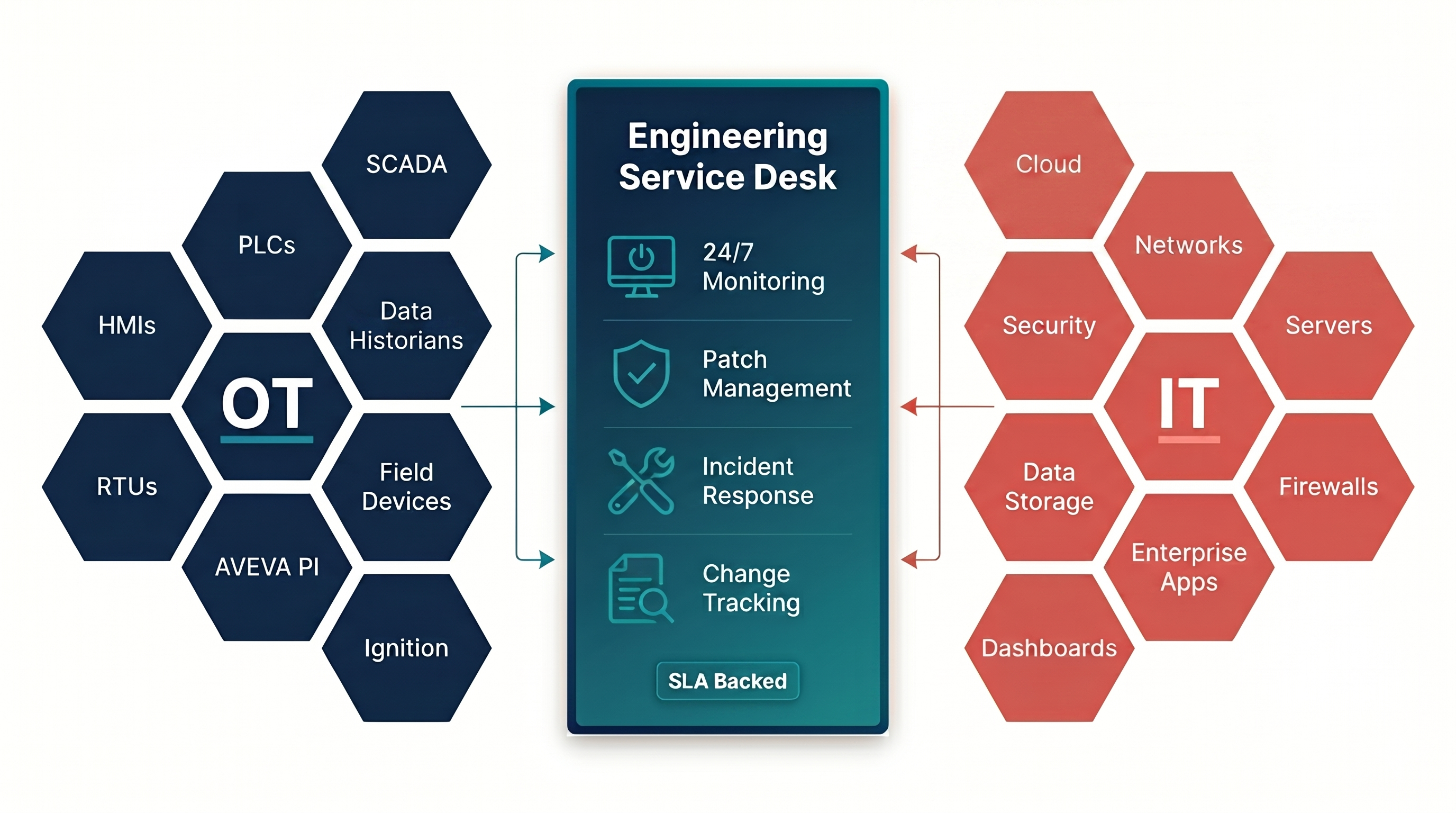
Casne's Engineering Service Desk sits at the intersection of OT and IT — monitoring, maintaining, and supporting the full stack around the clock. © Casne Engineering 2026.
Archive and storage degradation. The PI Data Archive writes continuously. As archives fill, new archives are created and if disk capacity, archive fragmentation, and shifting policies aren't actively managed, write performance degrades and data loss becomes a risk. Storage issues develop gradually, often without explicit error messages, until historian performance becomes noticeably impaired or data gaps appear in reports.3 By the time the gap is visible in a dashboard, it may represent days of missing operational data.
Interface and connector failures. PI Interfaces and PI Connectors are the ingestion layer they pull data from field equipment and deliver it to the Data Archive. When an interface stops sending updates, affected tags go stale. In a monitored environment, these faults surface in minutes. In an unmonitored one, they accumulate quietly: operators see frozen values and assume process stability, while the historian builds a silent gap that may span days or weeks.2
Security patch exposure. AVEVA publishes security updates for PI Data Archive, PI AF Server, PI Vision, PI Connectors, and related components on a rolling basis. In 2024 and 2025 alone, AVEVA issued more than 10 critical security advisories addressing vulnerabilities in PI Data Archive, PI to CONNECT Agent, and multiple platform components.4 Applying these patches in a live OT environment requires compatibility testing, change management approval, coordinated maintenance windows, and post-patch validation a process that gets deferred indefinitely when there's no dedicated owner. Unpatched PI components in environments connected to enterprise networks represent exactly the kind of IT/OT boundary risk that regulators and cyber insurers are now scrutinizing.
AF structure and calculation drift. PI Asset Framework is the contextual layer that organizes operational data for dashboards, analytics, and reports. Tag renames, equipment changes, and process modifications can break AF attribute references and AF calculations without generating obvious error messages. Analyses producing invalid outputs or broken calculations can silently corrupt the derived values that operators and engineers depend on and they often go undetected until a specific report pulls unexpected numbers.3
Dead tags and access control accumulation. Large PI environments accumulate stale tags points no longer connected to live equipment that consume license capacity and create noise. Similarly, user accounts and access permissions accumulate without regular review: former employees, contractors, and service accounts with elevated permissions that no longer reflect current operational needs. In regulated industries, these aren't just maintenance issues they're audit findings.3
What the ESD Does for PI System Environments
The Casne Engineering Service Desk provides 24/7/365 run-and-maintain coverage for AVEVA PI System deployments the Data Archive and storage layer, PI Interfaces and Connectors, PI AF structure and calculations, PI Vision, security patch management, and the Windows servers and networks the platform depends on. We monitor, manage incidents, coordinate patches, conduct periodic health assessments, and maintain the change documentation that compliance reviews require all under a formal SLA with guaranteed response times and a senior PI specialist available around the clock.
This isn't a generic managed services offering. Casne's ESD team carries direct AVEVA PI experience Data Archive administration, AF modeling, interface configuration, PI Vision management, and OT security hardening. We've supported PI environments across utility, manufacturing, and data center operations. That means we can triage a Data Archive fault, trace a broken AF calculation to its root cause, and coordinate a patch cycle through a formal change management process without pulling your in-house engineering team off operational priorities. Every member of our ESD team holds an AVEVA PI System Certification.
Why It Matters Now
The PI System has been the operational data standard for heavy industry for decades. Tens of thousands of industrial sites run it. That installed base means the platform will continue to require administration, patching, and support regardless of what happens to AVEVA's product roadmap or pricing model. If anything, the transition from OSIsoft to AVEVA has introduced new complexity new licensing structures, new cloud integration options, new component versions that places additional demands on the engineers responsible for keeping the platform current and secure.
The cybersecurity exposure is growing in parallel. PI environments that communicate with enterprise networks feeding dashboards to corporate users, pushing data to cloud analytics platforms, or connecting to IT-managed infrastructure sit at exactly the boundary that OT security frameworks are designed to protect. CISA, NERC CIP, and IEC 62443 all address this boundary. An unpatched PI Server with outdated access controls and no documented change history in a network-connected OT environment is not a theoretical risk. It's a concrete one and the window for addressing it quietly is closing.5
The staffing math doesn't improve on its own. OT engineering teams are short across virtually every sector that runs PI. The engineers with PI expertise are in high demand, frequently supporting capital projects, and rarely available to spend a day doing archive maintenance, running health checks, and reviewing security advisories. That work needs a dedicated owner not a shared responsibility that falls to whoever has time.

Comments