
WHY UTILITIES NEED DEDICATED RUN-AND-MAINTAIN SUPPORT — NOT JUST A PROJECT TEAM
Utility operational technology systems support critical infrastructure where reliability, availability, and data integrity are essential to daily operations. A historian that stops collecting. A SCADA interface that quietly drops tags. A patch that never got applied because no one owned it. These aren't dramatic failures — they're the slow drift that erodes system reliability until something actually breaks.
The honest reason it happens: the people responsible for these systems are already stretched thin. In most utility OT environments, there is no dedicated OT administrator. The engineer managing your PI historian is also supporting field devices, fielding operator calls, coordinating with IT on network changes, and contributing to capital projects. Your OT systems are one responsibility among many — and day-to-day system health is exactly the kind of work that gets deferred when everything else is on fire.
Run-and-maintain support refers to the ongoing monitoring, administration, patching, troubleshooting, documentation, and lifecycle management required to keep OT systems healthy after a project has been completed.
The real problem isn't neglect — it's that one person is wearing five hats. Monitoring, patching, incident response, change documentation, and vendor coordination all need dedicated ownership. Without it, the work doesn't disappear; it accumulates quietly until it becomes a crisis.
Dedicated support also reduces institutional knowledge risk. When critical OT systems rely on a single engineer or administrator, vacations, turnover, and competing priorities can quickly become operational vulnerabilities. A structured support organization provides continuity, documented processes, and shared expertise that remain available regardless of staffing changes.
The push toward IT/OT convergence has made this harder, not easier. Utility OT systems now sit on enterprise networks, integrate with cloud platforms, and fall under the same cybersecurity and compliance scrutiny as IT infrastructure. But the skillset required to manage a PI System historian or an Ignition SCADA gateway is fundamentally different from managing a standard IT help desk ticket. Most IT support organizations aren't equipped for it — and most OT engineers didn't sign up to be system administrators.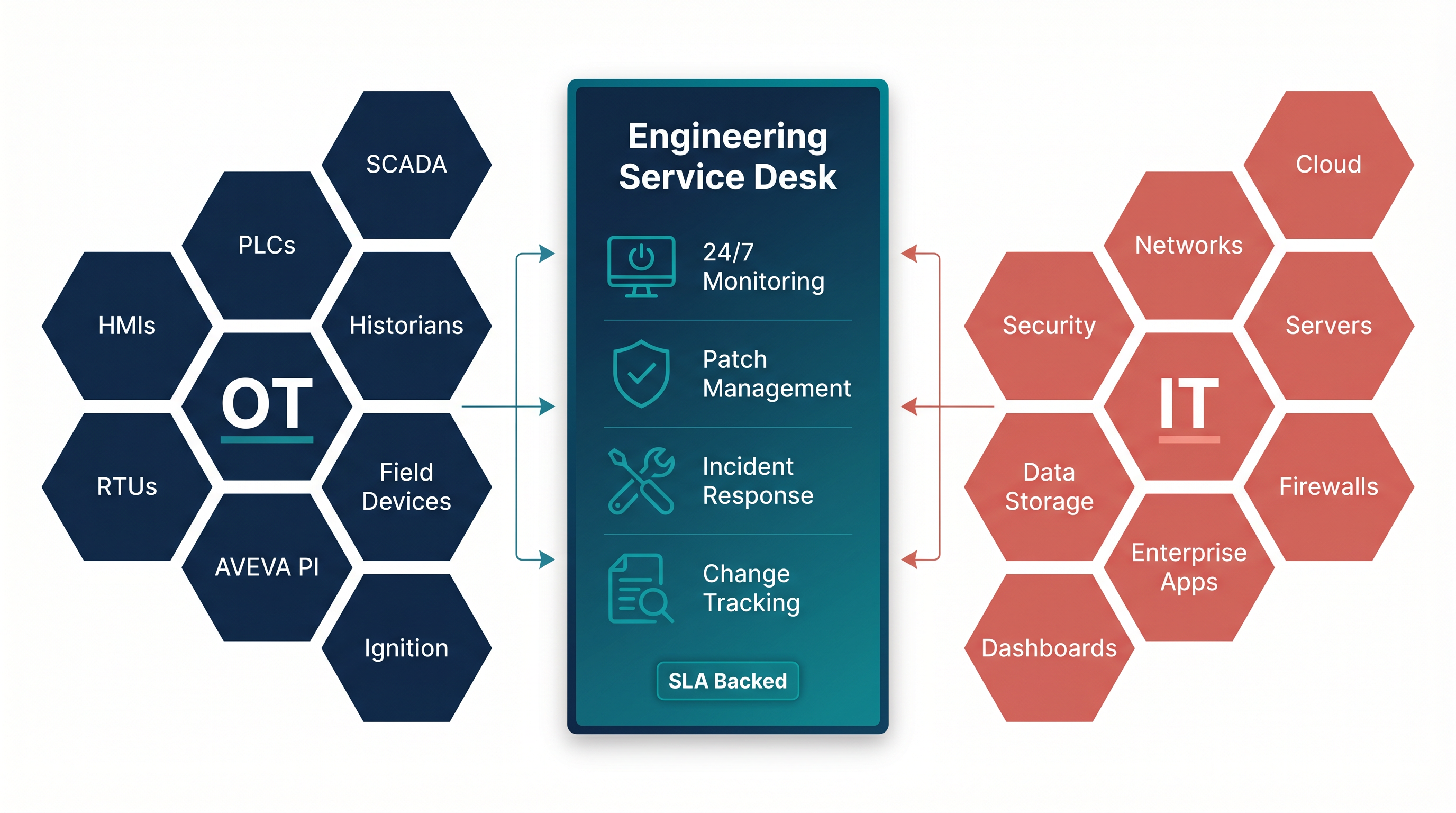
Casne's Engineering Service Desk sits at the intersection of OT and IT — monitoring, maintaining, and supporting the full stack around the clock. © Casne Engineering 2026.
What the ESD Does for Utility OT Environments
The ESD provides 24/7/365 run-and-maintain coverage for the systems utilities depend on most — Data Historians, SCADA platforms, OPC infrastructure, HMI environments, and the servers and networks underneath them. We monitor system health, manage incidents, coordinate patching and vulnerability remediation, maintain configuration and change records, and provide engineering-level support under a formal SLA with guaranteed response times and access to OT engineers 24x7x365.
This isn't a generic IT help desk. It's engineering-level support from a team that understands ICS and OT environments — the kind of dedicated ownership that lets your engineers and operators stay focused on operations rather than system administration.
What This Looks Like in Practice
Two examples from our work illustrate how this plays out across different utility environments:
https://casne.com/enel-green-power-operational-technology-service-desk
https://casne.com/yakima-valley-biomethane
Why It Matters Now
Regulatory pressure on utility OT is increasing. NERC CIP, AWIA, and state-level requirements are raising the bar on patch management, change documentation, and incident response — exactly the areas that fall apart when system ownership is fragmented across roles. Having a named support team with formal SLAs and audit-ready documentation isn't just operationally smart; it's becoming a compliance expectation.
If your OT systems are operating on best-effort maintenance with limited internal resources, it may be worth evaluating whether dedicated run-and-maintain support could reduce operational risk and improve system reliability. Casne's Engineering Service Desk is available to discuss your environment and support requirements.

Comments